Showing posts with label R-Word. Show all posts

Thursday, April 4, 2013

Dream

"The whirlwinds of revolt will continue to shake the foundations of our nation 
until the bright day of justice emerges."
-- Rev. Dr. Martin Luther King, Jr.

Today is April 4th.

Forty five years ago today, a man named Martin Luther King Jr. was shot to death for speaking out about injustice, about poverty, about the denial of basic human rights and dignity.  His words, his actions shone a light into the darkest corners of prejudice and hatred.  

Eighty-two days ago, a man named Robert 'Ethan' Saylor died face down on a floor in a Maryland movie theater.  He died of positional asphyxiation after being handcuffed by three off-duty deputies who were moonlighting as security guards at the mall next to the theater.

His death too, has been ruled a homicide.

Ethan was not a civil rights leader.  He was a man who will always be defined by his Down syndrome.  His death is exactly what Dr. King was talking about.

It seems to be an easy thing, dismissing this man's death.  He had a developmental delay.  He looked differently, spoke differently.  Interpreted the world around him differently perhaps.  Took a little longer to respond to things than you or I probably.  The different.  The other.

Ethan died because he had Down syndrome.  Not that his chromosome killed him, or that his health issues, probably treated less aggressively due to his having Down syndrome, caught up with him quietly in his sleep.  He died because he did not live up to the stereotype of a happy, smiling, hugging man with DS.   He died, handcuffed by three sets of linked cuffs, in a 'hogtie' position, on the filthy floor of a theater.
"...a promise that all men...would be guaranteed the unalienable rights of life, liberty, and the pursuit of happiness"
There is a lot of anger in the various DS "communities" out there.  As parents, we often try and shield our kids and ourselves from the ugliness that is out there.  We involve ourselves in our chosen groups and turn our focus inward.  We get complacent, insular... and often forget how terrible those who were different had it in the past. We forget how hateful society really can be.

With Ethan's death, our innocence has been lost. 

It is painfully clear that this can happen anywhere at any time.  This isn't just a random incident isolated to the state of Maryland.  This story comes to us from San Diego.  This story comes to us from Guatemala. This story comes from the UK, where a family was asked to leave the theater as their child with DS was "laughing too loud" at a comedic film.  This story comes from New Jersey, where a teenaged couple, instead of being taken to the correct seats, were separated and made to sit elsewhere. 

There is a lot of anger floating about.  Although ruled a homicide, those that are responsible for Ethan's death walk free.  In fact, at first they went back to their regular day jobs as if nothing had happened.  After a few weeks, they were placed on "Administrative leave".  There is a demand for justice, for this life lost.
"I have a dream that one day this nation will rise up and live out the true meaning of its creed: "We hold these truths to be self-evident: that all men are created equal."
We have lost our blinders when it comes to how severe the hatred is out there.  Each new story tries to excuse the actions/inaction of everyone in that theater by portraying Ethan as a monster.  Instead of "young man dies", he had "anger issues".  Instead of "positional asphyxiation", he had "heart problems".  There aren't people carrying placards outside every government building and movie theater denouncing the existence of those with Down syndrome, true.  However, every online source covering this case has a litany of comments from ignorant, vitrol spewing people.  I'd re-invoked my rule of "don't read the comments" some time ago, but many parents now are viewing the extent of society's contempt for our children with reoccuring themes such as "where was his handler?", "anger issues", "retard strength" and yes, even "broke the law/deserved punishment" and "he deserved to die".   We tend to shield ourselves against such negativity; it is now there, in black and white, in our faces. There is no escaping it now;  we can't chalk this up to childish pranks or attention seeking ''shock jock' disc jockeys.  These are our neighbours.  They hate our kids.

Many people are voicing feelings of abandonment by the organizations representing their children.  People have realized in the last while that the charities that they have been donating to all these years do not advocate as they claim to do.  The giants are slumbering.  Although one has roused and briefly mumbled, those with the loudest voices of all are silent.  Passive.  Allowing their inaction to speak for them instead.
"I have a dream that my four little children will one day live in a nation where they will not be judged by the color of their skin but by the content of their character..."
We would like to think that all our children, not just the neurotypical ones, can walk freely with their heads held high and achieve whatever it is that they wish to achieve, to live to their potential.  That the shape of one's eye, the 'tone' of one's muscle, will mean nothing more than the beautiful variance that is humanity.  We parents feel keenly the looks, the stereotypes, the assumptions. Those living with Down syndrome are stung by the inequality and lack of representation.
"I am not unmindful that some of you have come here out of great trials and tribulations..."
I was talking to a friend one night who looked at me at one point and said "It is never "off" for you is it?  There is no time when you are free from all of this [prejudice]?"

No.  There isn't.

There is a certain bone-weariness that comes with that. It in turn, makes you want to isolate yourself further.  To stop talking.  To hide once again and pretend that this is all not happening.
"But there is something that I must say to my people who stand on the warm threshold which leads into the palace of justice. In the process of gaining our rightful place we must not be guilty of wrongful deeds. Let us not seek to satisfy our thirst for freedom by drinking from the cup of bitterness and hatred.

We must forever conduct our struggle on the high plane of dignity and discipline..."
I've heard this one too: "The problem with this is that there are too many passionate parents."  This is right, but not for the reasons that the author intended.  Parents are all too human as well.  Full of the same foibles as any random sampling of the population would be.  If anything should put to rest "only special parents are given special children" chestnut, it is a good look at this membership into the "Trisomy 21 Parenting club".  You will find the same personality disorders, the same secondary gains, the same attention seeking behaviour.  Because of this, some of the louder voices are too easily perceived as shouting randomly, by not only those minds we wish to enlighten, but by our own people.  Instead of  coming together, we are driven further apart.  Some do quite successfully talk the talk and walk the walk... but still, will never be able to fully accept their own flesh and blood as their own and it saddens me even further.
"We have also come ... to remind America of the fierce urgency of now. This is no time to engage in the luxury of cooling off or to take the tranquilizing drug of gradualism. Now is the time to make real the promises of democracy. Now is the time to rise from the dark and desolate valley of segregation to the sunlit path of racial justice..."
This is a time of struggle.  This is a time of seeking social justice.  This is not a time to 'let nature take it's course' or win hearts with cute pictures.  This is a time of action.  We don't have the luxury of doing it any other way at the moment.  Ethan's death has crystallized exactly what is wrong with society and its treatment of those with Intellectual Disabilities/Developmental delays.  If we let this go, if we lie down and go quietly into the night as those that make policy would have us do, we are globally condoning the prejudice and brutality in the articles I linked earlier.  If we stop raising our voices and getting "uppity", if we allow things to continue on in more gradual way, we will be shown our "place" again and expected to stay there.

My son does not have a "place", other than at his parents and siblings side.

We need to take action.  Regardless of what country, what city you live in, these events or ones similar are occurring there as well.  Those with Down syndrome, those with Intellectual Disabilities and Developmental Delays are being disregarded out of hand.  It is time to stop being the other

We need to write.  We need to speak out.  We need to act.  We need to represent those that have no representation.  We need to get our message heard and our sound amplified by those with bigger voices.  We need those living with DS to have a larger say.  We need more self advocates.  We need visibility.

I too have a dream, you see. 

Raise your voice.

Let freedom ring.

----------------------
King, Martin Luther, Jr. "I Have a Dream." Lincoln Memorial, Washington D.C. 28 Aug. 1963. Speech. 

[Originally appeared on Down Wit Dat]  

Wednesday, March 6, 2013

Spread the Word "Day of Action" Blog Symposium

Today, 3:6:13 is a Day of Action.  Today is "Spread the Word to End the Word" Day.  If you are unfamiliar with this campaign and pledge, follow this link.

In honour of today, Down Syndrome Uprising is Spreading the word by hosting a blog symposium.  People from all over the world are encouraged to post about the R word, read what others have to say and comment.  Let's keep the dialogue going.  Let's Talk... about Respect.


 photo 625451_10151249421101157_509799039_n_zps5591372b.jpg
Take the Pledge.  End the R-Word.

Please copy and add the code to your post.  If you are having difficulty doing so, please click here.  (Examples of both layouts are provided.)

For Blogger (Java friendly) Users:

<div style="text-align: center;">
This Blog Symposium brought to you by:<br />
<br />
<a href="http://downsyndromeuprising.blogspot.com/" target="_blank"><img alt=" photo DSUbannersmall2_zpsfa60ecbb.jpg" border="0" src="http://i1113.photobucket.com/albums/k501/Psychojenic/DSUbannersmall2_zpsfa60ecbb.jpg" /></a></div>
</div>
<div style="text-align: center;">
Add your R-Word post now!&nbsp;</div>
<div style="text-align: center;">
<!-- start LinkyTools script -->
<script src="http://www.linkytools.com/thumbnail_linky_include.aspx?id=187654" type="text/javascript"></script>
<!-- end LinkyTools script --></div>
</div>

For WordPress (non-Java friendly) Users.:

<div style="text-align:center;">
This Blog Symposium brought to you by:<br />
<br />
<a href="http://downsyndromeuprising.blogspot.com/" target="_blank"><img alt=" photo DSUbannersmall2_zpsfa60ecbb.jpg" border="0" src="http://i1113.photobucket.com/albums/k501/Psychojenic/DSUbannersmall2_zpsfa60ecbb.jpg" /></a></div>
</div>
<div style="text-align:center;">
Add your R-Word post now!&nbsp;</div>
<div style="text-align:center;">
<!-- start LinkyTools script -->
<p><a href="http://www.linkytools.com/wordpress_list.aspx?id=187654&amp;type=thumbnail">Click here</a> to enter your link and view all the participating blogs...</p>
<!-- end LinkyTools script -->
</div>

Tuesday, October 23, 2012

A Brief History of Down syndrome - Part 5: From Education to Eugenics

A Brief History of Down syndrome, Part 5: From Education to Eugenics

The training schools for the developmentally delayed in the middle 1800's were an instant success;  although they did not offer a cure, they did show improvements in behaviour, physical prowress and social interactions.  Many students were able to develop skills that would ensure a successful return to their loved ones.

Sadly, a post-Civil war poor economy did not allow for many employment opportunities for the developmentally disabled in America, no matter how well trained.  Jobs were scarce and there were many new immigrants who were willing to work for low wages.  People with disabilities were looked at as burdens and were counted (once again) amongst criminals, prostitutes and vagrants in the census reports. 


Not surprisingly, there was a simultaneous increase in the demand for training schools;  many of the existing schools expanded and initially served a broader disabled community.  However, as time went on, the schools quickly became asylums, providing only rudimentary care for their 'inmates'.  By 1875, many US states had started construction on institutions for the developmentally disabled.  The leaders of these new institutions were now doctors;  1876 saw the establishment of the Association of Medical Officers of the American Institutions for Idiotic and Feeble-Minded Persons (who would later become the American Association for Mental Retardation, now the American Association of Intellectual and Developmental Disabilities or AAIDD).  One of the primary purposes of this organization is taken from Article II of their constitution:
"The object of the Association shall be the discussion of all questions relating to the causes, conditions, and statistics of idiocy, and the management, training, and education of idiots and feeble-minded persons; it will also lend its influence to the establishment and fostering of institutions for this purpose." 
How Boys are Taught Simple Manual Labor, Massachusetts School
for the Feeble-Minded, William A. Webster, circa 1903.
Photo courtesy of the Harvard Art Museums/Fogg Museum
The institutions were now medically based,the differently abled now "sick" and in need of treatment (and surely, cure).  The superintendents believed that each disability should be grouped accordingly, creating a colony system within the institution itself.  Examples of such are an "epileptic colony", a building for "low-grades" or lower functioning individuals and a "girls cottage".   The focus had shifted from educating young people to return to the community to housing a large number of individuals of all ages and abilities. To stay financially solvent, these institutions began to train some of the higher functioning inmates to work in the asylum.  They provided cheap (slave) labour as the institutions became self sufficient, often running their own farms and even power plants.  Often located in very rural settings, the inmates were essentially cut off from the rest of society.  Cheap farm land and abandoned farms in depressed rural areas was purchased  allowing for the creation of "farm colonies" where higher functioning "patients" provided hard physical labour, without pay, to produce enough food for one of the large institutions.  These farms also relieved some of the overcrowding of the main institution.  Care was custodial at best, with the idea that safety and security was all that could be expected. 

Both Seguin and Howe, two physicians, educators and advocates for the disabled, foresaw the new direction that the schools were heading to.  Instead of presenting the keynote address for a groundbreaking for a new institution in New York, Howe begged them not to open it instead.  Regardless, the populations in the institutions continued to rise.  There were, on average, 250 people per institution in 1890;  that number had doubled by 1905.

Walter E. Fernald, the then president of the American Association on Mental Deficiency, described the institutions as an economic solution to the disabled.  In his words, "each hundred dollars invested [in institutions] now saves a thousand [dollars] in the next generation.".  Money allocated to the poorhouses and almshouses by the state was already being redirected to the large institutions as well.  By the close of the century, the annual cost of housing a person in such a place ranged from $150 to $250 USD.  In a generation, the public view towards the differently abled, especially the developmentally delayed, had gone from one of compassion and eduction to fear and segregation.  By 1923 there were over 80 "schools", "farms", "hospitals", "institutes" and "academies" for the disabled.   With it's inmates no longer welcome in the outside world, these asylums could now say that they were relieving society of a great burden. 

Protect Us from the Feeble

As the institutions grew and conditions continued to worsen, the public perception of the disabled and "feeble-minded" continued to decline as well.  Such "illnesses" were considered to be moral failings of the person or their parents.

Immigration to North America was at an all time high and by 1900, one in seven Americans was born elsewhere.  Fear and suspicion of both immigrants and disabled persons was also growing exponentially;  this was only augmented by government actions that segregated and excluded these new Americans, which in turn only reinforced and systematized prejudices.  The US Public Health Service classified the following together as one group: "criminals, defectives and delinquents". With this in mind, the Public Health Service, administered the new Binel IQ test to immigrants at Ellis Island.  Devised originally by the French psychologist (on behest of his government) Alfred Binet,  it was created to quickly identify developmentally delayed children for placement in 'special education'.  Even Binet himself felt that case studies were more appropriate, however such assessments were lengthy and costly, especially on the larger numbers of people seeking entrance into such facilities.  However, there were three codicils to his test:  one, the scores are not to be considered permanent. Two, the scale was to be a rough guide for the identification and aid of developmentally delayed children and, three a low score did not determine an innate incapability on the part of the child.  However, these tenets were easily brushed aside and from the testing at Ellis Island, it was determined that "79% of the Italians, 80% of the Hungarians, 83% of the Jews, and 87% of the Russians are feeble-minded.", a conclusion which now, scientifically, legitimized the marginalization and prejudice.

As time went on, the view of the institutions shifted further from education to protection;  once again the developmentally and physically disabled had become demonized and the public now needed protection.

The Rise of Eugenics

Much like in centuries past, the uncertainty of the economy and world affairs provided a fertile ground for the reappearance of ideas now known as Social Darwinism and Eugenics.  The term "Eugenics" was coined in 1883 in Inquiries into Human Faculty and Its Development, a book written by Sir Francis Galton, cousin to Charles Darwin.  The Eugenics movement advocated for the improvement of society through the elimination of certain traits.


Misinformation and propaganda began to circulate, citing supposed immorality and the danger to the future of humankind.   Feeble mindedness needed to be controlled, if not cured.  The term moral imbecility also included such things as juvenile delinquency, behaviour problems and epilepsy and was regarded as a main cause of societal ills including poverty, alcoholism, prostitution, violence and crime in general. Often, those who committed crimes were portrayed in the newspapers in such a way to suggest developmental delay.
 
Henry Goddard, a psychiatrist at The Vineland Training School, translated the Binet IQ test into English and made a few adjustments;  he developed a category of developmental delay known as "moron", which became synonymous with 'moral imbecile' and reinforced the notion that feeble mindedness and therefore delinquency, was hereditary.

John Harvey Kellogg, the inventor of corn flakes, ran a holistic sanatorium in Battle Creek Michigan.  In 1906, he created the Race Betterment Foundation, which would hold Eugenics conferences at the sanitarium in the years to come (1914, 1915 and 1928).

The year 1909 saw the publication of The Eugenics Review, the journal of the Eugenics Education Society in Britain. Galton, who was the honorary president, wrote the foreword.

In his 1910 book, Eugenics, The Science of Human Improvement by Better Breeding, Charles Davenport speaks of the formation of a 'Committee on Eugenics' from the American Breeder's Society including such famous names as himself, David Starr Jordan, botanist Luther BurbankAlexander Graham Bell, zoologist V. L. Kellogg, Swiss psychiatrist (and future president of the American Psychiatric Association) Adolf Meyer, naturalist J. Arthur Thomson, W. E. Castle, Charles HendersonAleš Hrdlička, Herbert J. Webber, C. E. Woodruff,  and Frederick A. Woods (who coined the phrase Historiometry).  According to Davenport, the "various duties of this Committee may be summed up in the three words:  investigation, education and legislation".  On the surface, this sounds very philanthropic, however, Davenport later continues on with the following:

"...This three or four percent of our population is a fearful drag on our civilization.  Shall we as an intelligent people, proud of our control of nature in other respects, do nothing but vote more taxes or be satisfied with the great gifts and bequests that philanthropists have made for the support of the delinquent, defective and dependent classes?  Shall we not rather take the steps that scientific study dictates as necessary and dry up the springs that feed the torrent of defective and degenerate protoplasm?"

"...If only one-half of one percent of the 30 million dollars annually spent on hospitals, 20 millions on insane asylums, 20 millions for almshouses, 13 millions on prisons, and 5 millions on the feeble minded, deaf and blind were spent on the study of the bad germ-plasm that makes necessary the annual expenditure of nearly 100 millions in the care of its produce we might hope to learn just how it is being reproduced and the best way to diminish its further spread."


A "sub-committee on Feeble-Mindedness" was also created;  it was "under the chairmanship of Dr. A. F. Rogers, Superintendent of the Minnesota School for Feeble Minded and Colony of Epileptics, and with Dr. H. H. Goddard, Director of the Department of Psychological Research at the New Jersey Training School for Feeble-Minded Boys and Girls."  Similar committees were created for other "problems", including "Insanity" (Chaired by Dr. Adolf Meyer), eye defects, deafness, crippled limbs, disease, musculature, etc.  The 'main committee' was given the task of obtaining records from American families regarding "the inheritance of characteristics of health, ability and temperament".  At the time of publication, only 300 of the 5000 family records forms had been returned to be studied, so it was suggested that "data of this sort might be collected by the national Bureau of Census...".   

Davenport, along with Harry Laughlin and financial support from Mrs. E. H. Harriman (the widow of the railroad baron), created the Eugenics Record Office in 1910.

Kallikaks, Morons and the Justification of Sterilization


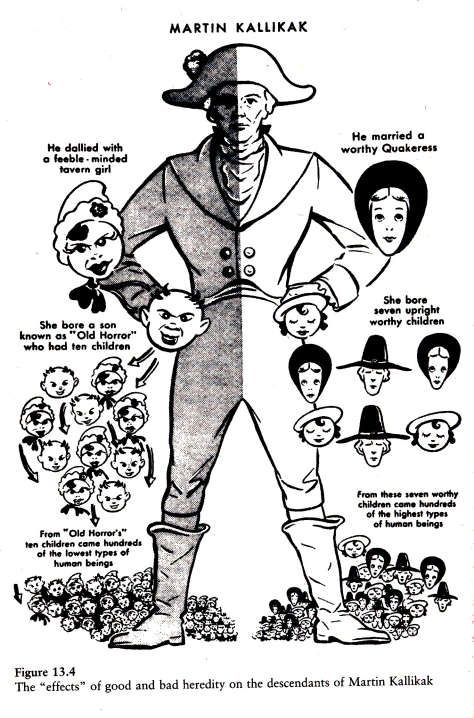
The lineages of "Martin Kallikak"
Goddard administered his modified Binet test again, this time to 1.75 million army recruits in 1917 and found that 40% of the white, male population was feeble minded.  By 1912, he had written The Kallikak Family: A Study in the Heredity of Feeble-Mindedness, a supposed genealogical account (and moral tale) of a patient in The Vineland Training School.  Named Deborah "Kallikak" (a name made up of the Greek word kallos or beautiful and kakos meaning bad)Goddard maintained that Deborah's great-great-grandfather was a soldier in the Revolutionary war who "dallied with a feeble minded bar maid".  Although he was to go on and marry a proper Quaker wife and father healthy upstanding citizens, his earlier indiscretion fathered another line.  That resulting lineage, Goddard maintained, not only produced Deborah, whom he described as:
"...a typical illustration of the mentality of a high-grade feeble-minded person, the moron, the delinquent, the kind of girl or woman who fills our reformatories.  They are wayward, they get in all sorts of troubles and difficulties, sexually and otherwise, and yet we have been accustomed to account for their defects on the basis of viciousness, environment or ignorance."


The caption reads: "Great-grandson of
"Daddy" Kallikak.  This boy is an imbecile
of the Mongolian type"
...but also a variety of 'degenerate' members of the family, including those felt to be feeble-minded, sexually immoral, alcoholic, insane, syphilitic, criminals, deaf, tuberculous or simply died in infancy. Many case studies of are provided with accompanying photographs, which, even to the most untrained eye of today, appear to be poorly altered to appear more monstrous. However, at the time, this publication did what it was supposed to do; provide 'proof' that feeble mindedness and therefore, all of society's problems, were hereditary.   

"There are Kallikak families all about us. They are multiplying at twice the rate of the general population, and not until we recognize this fact, and work on this basis, will we begin to solve [our] social problems."

 It also validated the use of segregation in an institutional setting and "...sterilization may be accepted as a makeshift, as a help to solve this problem because the conditions have become so intolerable." Clearly, sterilization was the solution for the time being, until something more permanent could be devised.

The first International Congress of Eugenics was held in London in 1912 (they would be held again in 1921 and 1932) .  Attendees of note were Winston Churchill, then the First Lord of the British Admiralty, Chief Justice Lord Alverstone, Lord Balfour and then ambassadors of France, Greece and Norway.  In the US, the Galton Society was created in 1918;  it further popularized eugenic theories through its newsletter the Eugenical News.  Contributors included racist authors Madison Grant and Lothrop Stoddard.

By 1915, many of America's prominent universities were offering courses on eugenics:  Brown, Harvard, Columbia and Cornell are among those that taught these theories.  This is not surprising given the academic backing of eugenics from such persons as psychologists Edward Thorndike and Leta Hollingworth, as well as psychometricians Carl Brigham and Robert Yerkes.  Goddard took his presentation on the road and using lantern slides, warned the masses of the "rising tide of feeble mindedness".

A 1917 movie, entitled "The Black Stork"  told the fictional story of a couple that were "ill matched" and as a result, gave birth to a disabled baby.  The baby in the movie was "mercifully killed" by starvation by eugenicist Harry J Haiselden, who not only starred in the movie as himself, was in real life was a prominent Chicago physician who refused to give life saving care to "defective" babies.  Not only were the dying infants displayed to journalists, but he also documented them publicly in the Hearst Newspapers.


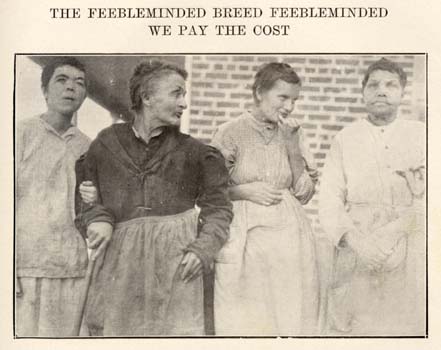
Photo from the North Carolina State Board of
Charities and Public Welfare Biennial Report
of the State Board of Charities and Public Welfare,
December 1, 1920 to June 30, 1922
The American Eugenics Society was formed after the second Intentional Congress and formed committees to better aid in popularizing their theories.  These committees included "Co-operation with Clergymen", "Sermon Contests", "Crime Prevention", "Selective Immigration" and "Formal Education".  They also sponsored "Fitter Families Contests" and Eugenics information booths at various state fairs.  An example of this is a display in Philadelphia in 1926 that featured flashing lights to illustrate the dire consequences of uncontrolled inferior procreation and the phrase "...some Americans are born to be a burden on the rest"The National Education Association's Committee on Racial Well Being also sponsored programs to help college professors include eugenic doctrine in their classes throughout the 1920's.

By 1924, the US Congress passed the Immigration Restriction Act, specifically targeting those from Europe and Eastern Europe, the majority of which had been labeled "feeble minded" a decade before.  Those who were differently abled with mild to moderate disabilities were now considered morons and part of the "moral menace".  As the institutions were overflowing, the superintendents, many of which have been named here as Eugenicists (and promoted the idea of the degenerate moron), 'paroled' the higher functioning patients after sterilizing them.  It did not take long however, for lower functioning individuals to also be sterilized, especially those who displayed habits considered to be obscene.  The men were forced to undergo vasectomies and the females underwent tubal ligation. 


Photo courtesy of the DNA Learning Center,
Cold Spring Harbour Laboratory
One contested sterilization case made it to the US Supreme Court in 1927.  In Buck v. Bell, Carrie Buck was an young woman that had been declared feeble minded and scheduled for sterilization.  A family tree, brought forth during the trial showed that she was the child of a feeble minded woman and that her then infant daughter was the same.  The Chief Justice, the iconic Oliver Wendell Holmes Jr., stated that:
“It is better for all the world, if instead of waiting to execute degenerate offspring for crime or to let them starve for their imbecility, society can prevent those who are manifestly unfit from continuing their kind.  The principle that sustains compulsory vaccination is broad enough to cover cutting the Fallopian tubes. Three generations of imbeciles are enough.”

Carrie was sterilized and it was found later that she was, in fact, of normal intelligence, as was her daughter who went on to win awards in school.  The entire family tree had been fabricated and her entrance into the institution was surmised to be a cover up of her rape at the hands of a foster-cousin, from which her daughter had originated.  Carrie went on to be paroled from the institution, got married and eventually died in 1983 in a nursing home.  She was buried next to her daughter Vivian, who had been adopted by Carrie's former foster parents (due to her supposed lack of competence) and died at eight years of age.  Buck v. Bell has never been overturned.

By 1928, Eugenics was taught in over 376 courses in the US, which covered approximately 20,000 students.  High school science textbooks between 1914 and 1948 presented Eugenics as fact, creating two entire generations that believed in segregation, restriction of immigration and sterilization of the "unfit".  Compulsory sterilizations of the developmentally and physically disabled were performed worldwide, including in Canada, Sweden, Switzerland, Denmark, Norway, Finland, Estonia, Iceland, Panama and the United Kingdom. The Eugenics movement eventually lost scientific credibility, but not before hundreds of thousands of developmentally and physically people had been sterilized in the name of social purity.


[Next time: Extermination]

----------

Buck v. Bell, 274 U.S. 200 (1927) <caselaw.lp.findlaw.com>

Burr Johnson, Kate. North Carolina State Board of Charities and Public Welfare Biennial Report of the State Board of Charities and Public Welfare, December 1, 1920 to June 30, 1922. Raleigh: North Carolina State Board of Charities and Public Welfare, 1922. University of North Carolina at Chapel Hill. The University Library. Web. <http://docsouth.unc.edu/>.

Davenport, C. B. Eugenics, The Science of Human Improvement by Better Breeding. New York: Henry Holt and, 1910. Print.

Goddard, Henery Herbert, The Kallikak Family: A Study of the Heredity of Feeble-Mindedness, (2009). College of Law Faculty Publications. http://digitalarchive.gsu.edu/col_facpub/7

Paralells in Time; A History of Developmental Disabilities, The Minnesota Governor's Council on Developmental Disabilities, 2012.

Proceedings of the Association of Medical Officers of American Institutions for Idiotic and Feebleminded Persons. Vol. 1,2. Philadelphia: J. B. Lippincott &, 1877. Print.

Selden, Steve. "Social Origins of Eugenics." Social Origins of Eugenics. University of Maryland, n.d. Web. <http://www.eugenicsarchive.org/html/eugenics/essay6text.html>.

[Originally appeared on Down Wit Dat