Showing posts with label Down Wit Dat. Show all posts

Monday, October 28, 2013

Advocacy


Down Syndrome Awareness Month (US) is slowly drawing to a close.

As you all pretty much know by now, I'm not exactly a fan of "awareness".  At all, actually. There tends to be a lot of confusion surrounding this and terms like awareness, advocacy, anger, prejudice, hatred...words that we encounter almost every day in this month of 'awareness' (if not every day for some of us).  It is this confusion that I hope to address.

To begin with, what most people attribute to awareness is actually advocacy.   When you teach, correct, explain, speak out, represent, whether subtly or more energetically, you are advocating for your cause, not spreading awareness.  Awareness comes in the form of recognition.  Trust me, if the demeaning imagery that people post in my groups and on my page is any indication, people are very aware that Down syndrome exists.  They may be utterly wrong and hateful, but they know it exists.  People with DS may (or may not) have reached partial visibility, but more awareness is not going to change that.  It's not that simple.  Advocacy will, by continuing to promote and further the cause towards true inclusion. 
 
Over the years I've become a little soured with awareness campaigns anyway.  I have always been leery of the trinkets and T-shirts and the like; the object may wear the symbol of whatever it is that it claims to represent, but the money you just paid for that shiny thing just lined a private pocket.  The idea of someone profiting off of these sorts of things makes me ill, frankly.  To give a well known example, October used to be very pink for me.  Instead of surrounding myself with mugs and pens and every manner of pink object, instead I would participate in Grand Dessert night with a group of colleagues.  Any money spent was out of our pockets and 100% of the funds raised by the event went to Breast Cancer research. But still, everywhere you look this month:  Pink.  Football players wearing pink shoes, pink towels, pink gloves. Pink mugs, pink bracelets, pink soup cans and pink memes.  "Pink-washing".  This survivor puts it more succinctly than I ever could.

Is it fair to compare Trisomy 21 to breast cancer?  No.  Down syndrome is not a disease.  Yes, there is a motley collection of conditions that may or may not accompany the triplication of chromosome 21, but in itself it is not a killer, nor is it something to "overcome".  One does not battle Down syndrome, you don't fight your chromosomes.  It simply is: a visual, intellectual and often physical disability.  There is no "hope" needed, other than one day perhaps society will realize how society itself disables hundreds of thousands with the condition every day.  It is not something to cure.  Much like most of the pink paraphernalia too, most of the DS awareness trinkets generate profits for private pockets... or worse, organizations that do not see the civil rights of those they claim to represent as their main focus.  They are multi-million dollar corporations, after all.

Awareness, sadly, rapidly turns into a forgotten pile of overpriced junk and a banner that you walk by without giving a second glance.  Advocacy, on the other hand, lingers.  Even if a person disagrees with your stance, they are at least thinking about it to formulate an answer.

The beauty of advocacy is that it can take many forms.  It can be a quiet, one on one discussion.  It can be a discussion group, either in person or online.  It can be a blog, an article, a visual representation or piece of art. It can be a petition, a rally, a march. You can pick what works for you.  Awareness is passive, effortless and the results negligible (in fact, it can further the "othering" of those it intended to promote to inclusion).  Advocacy involves a little effort and the results are obvious in the disability community in the last 50 years.

Advocates ask questions and wonder how things will get better and what they can do to affect that change.  Sadly, in the world of DS advocacy, especially since it rests primarily in the hands of parent advocates, most people are fearful.  Fearful of the future, fearful of their own advocacy and dare I say it in some cases, fearful of their own children.   In Western culture, emotions are considered suspect, unproductive and the antithesis to thought or rational discussion.  As I've said before, I disagree wholeheartedly.  Anger can be a tool, a motivating force.  Anger can be the impetus, the catalyst that gets one moving towards affecting change.  Passion is what sustains that fire.

Sadly, there are many folks out there that are terrified of the possibility of insulting someone that might be an ally.  This in itself is a post for another day, yet it bears mentioning that anyone, myself included who asks why, who rejects this model of 'advocacy' is considered "hate filled", dangerous and ultimately a crack pot. 

I think folks need a reminder of what hate looks like.  This was posted to my Google community a few weeks ago:
[Image: caricature of an adult male with Down syndrome.  The caption reads
"Congratulations, your kid has Down Syndrome!"  The word balloon
from the man reads "I can count to potato".]

And then there is this:  neglect and abuse perpetrated by family, not to mention murder or attempted murder, stories of which are not decreasing in prevalence.  There is this, the historical systematic disregard of the those deemed "unfit" .  Let's not forget the wholesale extermination of those same people.  Not in the least is the systematic isolation, abuse and neglect of hundreds of thousands of lives at the hands of 'caregivers'.  

This is hate.  This is the stuff that motivates things like the image that I posted above and the concept of "control" and the same disregard that is being utilized here.

Asking why?  That is not hate. 

I am angry about continued injustice.  I'll wear that mark, your tattoo for that one.  But, it's for a damn good reason.  I am passionate about this subject.  I will continue to rattle chains and ask questions.  It is what I do.

People, regardless of ability, are people and should be accepted unconditionally.  Acceptance is not something that is earned or has to be proven.   Inclusion is not something that has to be begged for, pleaded for,  hoped and wished for, tiptoed around, afraid the eggshells will crush.  Both are words that get bandied about as well. 

That's the awareness we should promote.  Not the awareness of Down syndrome being a real thing that exists, but realizing how we view and treat people with disabilities.  Aware of the ableism, aware of the paternalism.  Ask every single being to examine how and why they see themselves as superior to others.  As better, stronger, faster.  More worthy, in control, able to make decisions. Aware of their own motivations, rhetoric and able views.  Then we'd be doing something. 

I'd advocate the hell out of that one too.

[Originally appeared on Down Wit Dat

Wednesday, October 16, 2013

Keeping it Real

I'm not unhappy.  My life is pretty good.

I know this will cause many of you to say "duh!" rather loudly, but there are a lot of people out there that still can't wrap their heads around this.

We're not unhappy.  Life is not hard.

Oh sure, we have our fair share of poopy diapers and kitchens that don't clean themselves.  There is drama.  There are skinned noses, hurt feelings and juice spilled from one end of my house to the other.  There is life, sure.

But we're happy.

There are a lot of things we would like to change, of that I have no doubt.  My husband is a stay-at-home Dad and I'm pretty sure he'd be perfectly happy to be back at his old job on those weekends when I work nights.  Surrounded by the aforementioned poopy diapers, swimming lessons, yell-y kids, an utter lack of privacy, quiet, and a complete thought; he'd be bananas not to.  But, he's not miserable.  The little ones go down for a nap at some point and the big one is content to hang out playing video games or quietly watching a movie in the mean time.  In a related story, I'd give my (honorary) left nut to be able to stay home with the kids.  Ok, I'd probably work one day a week, but to not have the responsibility of everything fall directly on my shoulders is a nice dream too.  Something for "when we win the lottery".  I think there are times when we would both change this part of our lives.

But, we're not unhappy.  Not in the least. 

Back in the early days, the just post-potential-diagnosis-but-not-sure-but-there-is-an-AVSD days, I was pretty sad.  I had a right to be, having just lost an Aunt I cared about very much (and didn't call much in her final years) and almost losing a very dear colleague in a horrific car crash.  I was also super pregnant with twins, super heavy, slow, in pain almost constantly and had to wear "Batman" anti-embolism hose that took me no less than half an hour to sweat my way into each and every day (and a nerve wracking 5 minutes to gently fix every time I had to pee, which at that point was eleventy-zillion times a day).  I was very sad when I was told about my unborn baby's diagnosis.  As time went on, I was told I was sad as I was "grieving my perfect baby".  Once they were here, once we knew about Wyatt's karyotype, once the twins were being kept alive in the NICU, I was told by a social worker and every piece of literature that I was handed that I was grieving.  As I continued to write updates to my family, that is how I described it.  Grieving.  Down syndrome was making me grieve.

I learned more about DS when I  got the babies home.  I also learned all about them, their individual personalities and got really into the swing of being the parent of infant twins.  It was then that I started to figure out my emotions a little more.  Ok, so DS wasn't what I originally imagined for the ONE baby that I thought I was going to conceive, but really, is that one little chromosome the source of all my sadness?  How about postpartum blues, post-surgical pain, recovery, or multiple personal losses?  In relation to my son's very real cardiac condition and the two fragile lives for which I was terrified, how about simple fear?  In retrospect that sounds like the recipe for postpartum depression, not my son's T21.  My own husband, upon hearing the "grieving" bit, argued with me.  "It's not like anyone has actually died!"  he said to me, exasperated. His mother had passed away suddenly in 2001 and it was this very real loss that he referenced now.  However, as told to us by that social worker that came to see us while we held our tiny sparrow babies, we were grieving our son's Down syndrome diagnosis.  It was only natural, after all. 

It took me quite some time to sort out my thoughts and feelings, probably compounded by my early return to work and the challenges I faced because of that.  As the children grew and my son became more of a boy and less of a baby, it became more evident how he was just himself, not some list of potential or actual diagnosis, not some 'special' baby, not the source of any familial discontent.  You see, I was told that my husband would leave me, that having a disabled, a "retarded" baby would ruin our lives, our marriage.  I was told by many "well meaning" people that it was a good thing that "Down's children" were so loving as I would have a forever child.  I was told by every medical source, by every appointment, by every medical professional that his extra chromosome would be the cause of a life of sickness.  I was told by a nurse that it was a good thing he was a boy, imagine how tragic it would be if he was a girl?  I was consoled for his birth, often multiple times a day.

I wish I could wave the realization of what I had attributed exactly to his extra chromosome off as a "D'oh!" or "A-ha!" moment, but the reality is I was deeply ashamed at my participation in the "love the baby, hate the disorder" mentality.  How I would love him "despite" his Down syndrome.  How as a family we would "overcome this obstacle".  You can see that here in past posts, as my writing changes and as I became more of the advocate that I am today.  Of course, I still had to really start to check my ableism at the door and realize quite a few more things, but you can see where I actually started to get it.

This month, being Down syndrome Awareness month in the US, you would expect me to be all over this like in years past. But, I'm not.  There's a lot of reasons here, ranging from current personal illness to personal perspective.  I'm not so keen on the "awareness" any more;  the colours, the gew-gaws, the posters.  Instead I'm all about the education or the advocacy part.  Even the activism part.  One could argue that I always was more of an advocate than awareness raiser given the topics of most of my posts in Octobers past... I may partially agree with you too.  However, as I've stated before, I'm done with awareness.

Instead, I'm going to advocate.  Hard.  It may not be pretty, it will probably seem to some like I'm shouting.  It may seem to some that I am full of hate and anger and all the things that I am accused of because I don't write about unicorns and rainbows and flatly refuse to accept things as gospel as they have been "always done this way".  So be it.  I will continue to challenge the stereotypes and whatnot that many people maintain as "fact" about Down syndrome.  There will probably be swearing.  This is what I do. 

That particular social worker is no longer telling new parents of children with T21 about grieving the diagnosis.  In fact, I've helped develop resources for new parents.  This blog is routinely passed out as a reference and I have been personally thanked by a great many people.  I am no longer misplacing my emotions onto my son.   He is no more or no less stellar than any other child of mine.  My desire from day one was to ensure that nobody else would either, even if I couldn't process or understand it properly.  We are not unhappy.

We're us.  Full of emotions and drama and all the little things that make up Team Logan.  Sometimes we're happy, sometimes we're sad.  Sometimes we're silly and giddy sometimes we get frustrated with one another, hell, even argue.  Sean and I worry about the things that other couples do, like money and our health and whether or not we're getting enough sleep.  The kids romp around here together, spreading chaos and love in their wake... and occasionally whacking each other with toys.  Down syndrome is literally a microscopic part of that, if it is really a part of that at all.

We're not unhappy. We're real.

I long for the day when no one is surprised at that statement.


[A banner for Down Syndrome Uprising, depicting the text "Down Syndrome Awareness Month,
with the word acceptance stamped over the word awareness.]

[Originally appeared on Down Wit Dat

Friday, August 30, 2013

Anger


"We need to call out the deaths of our people as hate crimes, not freeze-frame our bodies in sparkle-filled glamour shots that make us so super-humanly other."

I'm angry.

Not in an uncontrolled wildfire of rage that would consume my every waking moment kind of angry...   My real world life exists somewhere between a painful sleep deprived haze and caffeine fueled tangentiality.  I don't have the time (or the energy) for such wild abandon.

But I am angry.

And that is a good thing.

Our culture, ever ready with a label, likens anger to unproductivity.  It is the work of evil, it only causes harm.  Most people don't seem to consider anger as a tool, as a medium for change.  But it can be.  In my world, we call it constructive anger.  It has a large role in cognitive-behavioural therapy and treatment for things such as PTSD.  An event happens, you react with anger, a normal human emotion.  Instead of being consumed by it however, you calmly evaluate why the event angered you.  Then you use the energy of your anger to motivate you to change the situation that made you angry in the first place.

Or, in the words of Alyssa at Yes That Too:
"People talk about anger like it doesn't accomplish anything.  That's just not true.  Anger can be fuel to provide energy for activism.  Anger can be how people realize something is wrong, that something needs to be fixed."
Anger is a very powerful force.  There is a lot to be angry about these days.  There is an awful lot that needs fixing. 
 
This week saw this hateful letter delivered to a home that is just over an hour's drive from mine.  A letter, so full of ableist poison (and almost illiterate ignorance) that it made me physically sick to read.  Naturally, people reacted in disbelief.  How could this happen?  How could this happen here?  This is obviously a hoax, right? And so on...  Although technically "not a hate crime" (as no threats of physical harm were made), these things happen to those with special needs all the time.  This family in Colorado is fighting with their neighbours who want their wheelchair ramp removed from the front of their home for fear it will lower property values.  This flyer was put up in the Portland area, presumably to shame those with "fake" disabilities.  This veteran was kicked off the boardwalk in New Jersey and issued a summons for his service dog. While on the subject of service dogs alone,  this story was published in the New York Post, lamenting "fake" service dogs and as Stephen Kuusisto put it, is "...one of the most willfully underhanded pieces about disability I’ve ever seen in a newspaper."

These stories aren't random and isolated incidents.  They, and many more like them, have occurred this month

Ableism, whether you wish to acknowledge it or not, is running wild in the Western world.

I shouldn't have to mention how society views people like my son Wyatt and his extra chromosome.  Still disregarded out of hand, people with developmental disabilities like Down syndrome are still the butt of jokes in popular culture.  Children with intellectual disabilities are still denied access to education that is mandated by law;  in 2013 it is astounding that parents are still having to fight when research has shown over and over that performance of all students is improved in an inclusive setting. 

The stereotypes abound with DS, many of which are perpetuated by the medical community that we look to for advice and information.  Also sad is the fact that many stereotypes are perpetuated by those that call themselves advocates.  I've stated before, anything that describes my son as anything other than human is wrong.  Period.

A big bone of contention are the faddish inspirational memes/pictures (A.K.A. inspira-porn) which are pumped out at an alarming rate by many organizations.  I was told once, by a group that produce and condone many of those images that they were doing such to be positive.  That new parents (and --- let's get real here --- those considering pregnancy termination) needed oodles of positivity.  That the way to make life better for kids like my son, was to surround everyone in positivity because it all boils down to a matter of marketing.

I guess it's bad marketing that forces young people with disabilities to be housed in nursing homes in some places due to lack of community supports. It must be marketing that stands in the way of achieving inclusive schooling and accessible lives.  Marketing is what allows those that run social media sites such as Facebook and Twitter to not even bat an eye when new groups or events are created to mock those with special needs.  Even better was being told by some of the same people that the Down syndrome community didn't want to appear "divisive" much "like Afro-Americans [sic] or women".

People with Down syndrome come in all sizes, shapes, colours, cultures, abilities and ages.  Just like everybody else.  Many of the memes and slogans simply perpetuate the "otherness", by employing pedestal ableism and by alienating those with DS from the larger disability community.  In the words of Lawrence Carter-Long, Public Affairs Specialist at the National Council on Disability:
"Still think "the only disability in life is a bad attitude?" Try ordering from a menu with a blindfold on, smiling your way up inaccessible stairs or reading non-existent captions on a YouTube video. Don't like my "bad" attitude? Then provide equal access. You'll be amazed at how much my mood improves. Oh... and while you're at it, please check your unexamined privilege at the door. Thank you. Have a nice day!"
There is real danger with these memes.  In the act of creating this image of perfectly posed happiness, it doesn't allow for real life, for real emotions.  If happiness and docile complacency are the norm, it must have been a complete shock to many when Jenny, an adult with Down syndrome, fought and won the right to choose where she wanted to live.  Generalizations and stereotypes set up unrealistic scenarios and are damaging, no matter how well meaning.  Pedestal ableism is still ableism.  Those cute little children will grow up one day and want to have sex and get jobs and do all the things that all adults want to do.  Continuing to infantilize adults with DS, to pat people on the head and endow supernatural abilities to chromosomes will not assist with the completion of these goals.  Continuing to perpetuate the stereotypes that other disability advocates have been breaking down for decades is not surprisingly, making people angry.  From
"No, fucking no, we are not myths! We are not some mythical other! We are humans."
Essentially, to keep from being seen as "angry", or running the risk of challenging any actual ableism, real life civil rights are not on the menu with these organizations and their "inspirational" memes.  Instead, in the name of marketing, there are eleventy billion soft-focus pictures out there that are intended to make Down syndrome more palatable to people.  To be like Wonder bread;  soft,  not much to chew, devoid of any nutritional content and bleached very white.

I was also a little shocked to learn that I am not supposed to have a voice.  My son with Down syndrome is only two years old and I don't have the "experience" nor have I paid my dues.  My choosing to speak up regardless, makes me an "angry" person (which one could translate as "uppity", as I obviously don't know my place).   I too get patted on the head by some, told that in time "I'll understand" why the community chooses to operate this way.  I'm almost 42, have been a mother for 7 years, am the mother of twins and have been a nurse for over 17 years.  When exactly will that be?  How old does my son have to be before I can call shenanigans on the unjust practices directed at him?  I'm not arrogant enough to presume what my son thinks and perceives or know exactly the man that he will grow into.  I don't know that about my other two kids either.  I will do my damndest however to ensure that he gets the education he deserves and that he gets to make his own decisions, whether my CV has the "correct" amount of experience or not.

That will be done with constructive anger.  And humour... but anger will be the fire that stokes the boilers into action.  There is a lot of work to be done.  I don't think that it is too much to ask that September contains less stories of hate and ignorance.  Or that the stories that feature disability in every Lifestyle section of every mainstream publication not be written by the able-bodied or parents that haven't fully accepted their children with disabilities. I don't think that it is too much to ask that equal access and inclusive education be automatically available.  I don't think that it is too much to ask that you stop labelling my kid, stop putting him in a little box that says "happy moppet" on the outside and expecting him to act a certain way, just because you believe it makes it easier for people to accept him.  The reality is, he as a real, live human being with fully dimensional thoughts and feelings... who is just as full of shit as the rest of us.

I will leave you with the words of Cheryl Marie Wade, a lady that I only came across a few years ago when I started reading disability history for my A Brief History... series.  She passed away last week.  She was seen by some as "angry" too, which is probably why her death didn't make the papers.
"We ain't smilin' inspiration for the latest worthy cause
But generation after generation changing the laws
Parents fighting for their children.
Kids fighting for their dreams.
Maybe you've be deprived,
Maybe all you know is Jerry's kids--
Those doom drenched poster children hauled out
once each year to wring your charitable pockets dry.
The tragic--but brave, victim.
We are also Jerry's orphans,
Proud freedom fighters,
Takin' to the streets,
Takin' to the stages!
Raising speech-impaired voices in celebration of who we are--
Radical.  True.  Passing the word..."

The only way that any of this is going to get done is through action.  Through anger.  Through outrage. Through calling out the unjust and affecting change where needed.  It's going to take sweat, tears, rivers of determination and some serious balls.  Not five minutes in Photoshop.

I'm angry.

It's a damned good thing.


Sparks II
Fire, good.
[Originally appeared on Down Wit Dat

Friday, July 26, 2013

A Brief History of Down syndrome - Part 7: Abused, Neglected, Forgotten


"Euthanasia through neglect..."
– Albert Deutsch

As World War II raged on, the number of admissions to institutions continued to increase.  The amount of workers in the institutions continued to decrease however, as more men were being drafted every day for the war effort. Overcrowding quickly became the norm once again, with patients in hallways and even sharing beds. Without privacy, without comfort, without possessions, without support, patients were completely dehumanized and ready targets for abuse.  Conscientious objectors, those citizens who refused to fight in the war for ethical reasons, were readily employed by the institutions to help fill the ranks.  It is these people that began to expose the horrors of mass violence and neglect.


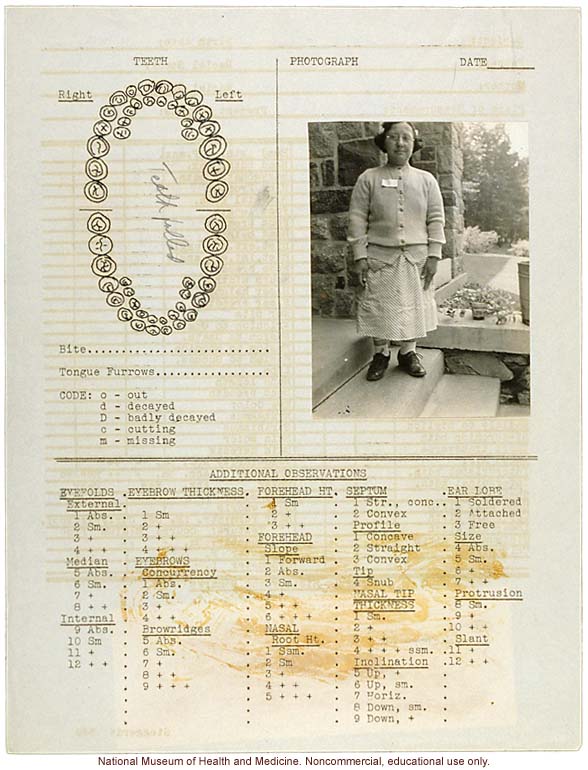
Patient record from Letchworth Villiage.
Photo courtesy of The DNA Learning Center
Those with disabilities were viewed as sick within a system that was highly medicalized;  each institution was run by physicians and staffed by nurses.  In the US, "state hospitals" housed the mentally ill while "state schools" held those with intellectual disabilities.  Areas within both were referred to in terms of "wards" or nursing units. "Patients" had "charts" and attended "therapy" or "programs".  People were referred to by their disabilities, thereby fostering more dependance on the medical establishment.  As feeble-mindedness was "incurable", patients under this system would require complete care as it was due to their "sickness" that people were institutionalized.  At the same time, many cities in the US continued to uphold "Ugly Laws", passed earlier in the century which made being disabled a crime.  This piece from the Chicago Municipal Code, sec. 36034 includes the following ordinance (that was not repealed until 1974):
"No person who is diseased, maimed, mutilated or in any way deformed so as to be an unsightly or disgusting object or improper person to be allowed in or on the public ways or other public places in this city, or shall therein or thereon expose himself to public view, under a penalty of not less than one dollar nor more than fifty dollars for each offense."
"We were greatly heartened by the appearance. It resembled a
college campus." Image courtesy of the Disability History Museum
After the war, doctors continued to urge parents to place their children in institutions.  During this time, having a child or family member with a disability was seen as a burden.  This story from The Rotarian in 1945 clearly displays the thinking of the day where "A Father" outlines the reason for institutionalizing his daughter for a "hopeless brain condition", diagnosed after a stay at a children's centre:
"After two weeks of observation and a brain X ray, the doctors decided that Mary Lou had a hopeless brain condition and recommended that for our own good and the welfare of the two children we place her in an institution."
The "brain x-ray" in this case is probably referring to a common diagnostic technique of the time, Pneumoencephalography, whereby small holes were bored in the skull, the protective cerebral spinal fluid drained from around the brain and replaced with gas, usually room air, oxygen or helium.  An x-ray was then taken.  The procedure was quite painful, caused headaches, nausea, vomiting and delerium that could last months until the body naturally replaced the cerebral spinal fluid. At worst, it could cause brain damage, paralysis and death.

"A Father" felt, if Mary-Lou was kept at home, it would disrupt family life and result in public ridicule and shame;
"If we did [keep her at home], we should have to curtail normal family activities, to make the environment as simple as possible, for, as is typical in such cases, Mary Lou became frantic over the bustle of the simplest household tasks. We knew, too, that we would have to devote the major part of our time to her, leaving her little brother to develop as best he could. We felt that he already had been neglected.

Also, having witnessed the ridicule and ill treatment which residents of our home town turned on the "village half-wit" and his family, we understood what keeping her with us would mean to our family..."
Her admission to a state facility was described as quick and efficient;  the results curative.  The story concludes with "And so tragedy came into a family that barely knew the word. We think, we pray, we have faced it wisely".

Between 1946 and 1967, the number of people with disabilities that were housed in public institutions in America increased from almost 117 000 to over 193 000, a population increase that was almost double that of the general post-war "baby boom".  As time went on, those admitted were becoming younger and their disabilities more pronounced. In regards to Down syndrome in particular, there were many cases where fathers and doctors conspired to have a baby institutionalized and then told the mother that the baby had died.


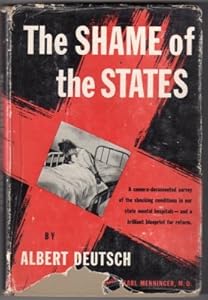
Albert Deutsch, who has been described as "a crusading journalist" wrote The Shame of the States in 1948, a compilation of his serial articles (previously published in major newspapers) which exposed the conditions of Letchworth Village in New York.  At the time, Letchworth was considered to be one of the better institutions in the US, as it had taken great pains in its creation to ensure that the overcrowding and abuses that had occurred in other places would not be repeated there.

Opening in 1911, Letchworth Village was one of the first completely encapsulated "state schools".  It included its own farm, power plant and hospital.  In the words of the first superintendent, Charles S. Little;
..."buildings should not be more than two stories high, nor should they contain more than seventy inmates; that the basements should not be used for purposes other than storage; that the dormitories should be at least two hundred feet apart, with sufficient space for each to have its own playgrounds; that there should be such separation of groups that inmates of one grade could not come in contact with those of another grade; and that in locating the buildings advantage should be taken of the natural beauty of the place."


Photo of Letchworth Village, looking like a college campus.
Patients were divided into separate categories or "grades" and were kept apart:  "moron", "imbecile" and "idiot", the last deemed "untrainable" and therefore initially excluded from admittance to Letchworth as they were unable, in his eyes, "to benefit the state".  As further described by Little:
"...it is a home where the feeble-minded and epileptic of all ages may be given the pleasures and comforts of the ordinary home. To this end our day rooms will be provided with games, colored pictures, flowers, music, etc. Each dormitory will have its own playgrounds where base-ball, football, basket-ball, croquet, etc., may be played by the children. Swings, hammocks, and picnic grounds will be provided for in a grove. Holidays will be celebrated in an appropriate and American fashion. A birthday party will be given each month for those having birthdays that month, making a gala evening for all. Inmates and employes will join in a weekly dance. There will be Sunday services appropriate to the condition and belief of the various inmates."
Residents tended to fields and flocks of livestock, built roads, shoveled coal and made toys at Christmastime.  It may sound idyllic, but by 1921, of the 506 people listed at Letchworth, 317 were between the ages of 5 and 17, while 11 were under the age of 5.  Their labour force consisted mainly of children and visitors and staff would report shortages of food and that the patients looked ill and malnourished. 

As time went on the population at Letchworth continued to grow.   Despite this, the state refused to construct any additional buildings and by the end of 1921, 1200 patients were housed there.  By the 1950's, that number had swollen to over 4,000.  Families were abandoning their relatives there to be forgotten.  Deutsch called it "euthanasia through neglect...".

Photographer Irving Haberman did a photo series on Letchworth which further exposed the conditions of the dirty, malnourished, neglected unkempt patients.  Residents are seen huddling naked in the day rooms. Similar exposés were done on many other institutions;  Time magazine would feature Byberry Hospital, also known as the Philadelphia State Hospital, in 1946 which exhibited appalling imagery of overcrowding, abuse and severe neglect.

The Nuremburg Code was created in 1947 and gave worldwide guidelines for human trials and experimentation.  However, many children in the state schools were still the subjects of experiments, including early testing for vaccinations. Many doctors at the time argued that these rules applied only to Nazi atrocities, not American medicine.  The first polio vaccine was in fact tested at Letchworth in 1950, after much lobbying by the then superintendent, Dr. Jervis.  By that time, Letchworth was considered to be highly regarded in the medical community, despite it's shady reputation in the greater community.  The Fernald Center in Massachusetts (superintended by eugenisist Walter E. Fernald) was the site of a joint experiment between MIT, Harvard University, The Atomic Energy commission and the Quaker Oats Company that exposed male patients to radioactive isotopes between 1946-1953.   Parents were given the following notice:
Dear Parent:
In the previous years we have done some examination in connection with the nutritional department of the Massachusetts Institute of Technology, with the purposes of helping to improve the nutrition of our children and to help them in general more efficiently than before.
For the checking up of the children, we occasionally need to take some blood samples which are then analyzed. The blood samples are taken after one test meal which consists of a special breakfast meal containing a certain amount of calcium. We have asked for volunteers to give a sample of blood once a month for three months, and your son has agreed to volunteer because the boys who belong to the Science Club have many additional privileges. They get one quart of milk daily during that time, and are taken to a baseball game, to the beach and to some outside dinners and they enjoy it greatly.
I hope that you have no objection that your son is voluntarily participating in this study. The first study will start Monday, June 8th, and if you have not expressed any objections we will assume that your son may participate.
Sincerely yours,
Clemens E. Benda, M.D.
[Fernald] Clinical Director
What was not mentioned to the parents was that the calcium given to their children in the milk was radioactive.

From the mid 1950's to the early 1970's, researchers at the Willowbrook State School in New York, carried out experiments on children that were deliberately infected with Hepatitis A and then treated with gamma globulin.  In the early years of the study, patients were fed infected fecal matter.  Later they would be injected with more pure versions of the virus.  Those that investigated the abuses surmised that the children would probably have gotten Hepatitis at Willowbrook anyway due to frequent outbreaks, so that it was probably "for the best" that they got it under such scientific circumstances.  At one point the school was closed to new admissions, except for the Hepatitis program.  This led to parents agreeing to allow their children to be the subjects of experiments, just to be able to admit their child to Willowbrook.  Either way, both parents and children were given very little choice whether or not to participate in the program.


Patients at Letchworth.  Photo courtesy of Bob Paley
Between 1917 and 1967, those that died at Letchworth, Willowbrook and other facilities like them, were buried anonymously. Steel or stone numbers were their only monument, possibly due to cost or at the families wishes of privacy.  Regardless, even in death, these people were denied their basic humanity, up to and including their own name.

In 1948 in Great Britain, the National Health Service (NHS) was introduced and institutions were now nationalized and transformed into actual hospitals (yet run like schools).  Emphasis then shifted to admitting only the most disabled and those with behavioural issues. Also that year, the National Assistance Act (which replaced the "Poor Laws" of Elizabeth I) made it a duty of local authorities to  arrange assistance for those who were deaf, blind, dumb, handicapped by illness, injury, congenital deformity or suffering from a mental disorder (which included developmental delays). This included increasing access to specialized education.


Image courtesy of The Minnesota Governor's Council on Developmental Disabilities
In 1950, another surge of advocacy took place in the United States.  Parents had begun to organize and had created the National Association of Parents and Friends of Retarded Children (which would later become The ARC).  By 1952 many US states had created legislation for educating children with intellectual disabilities (although those that were classified "moderate" to "severe" were excluded).  As the 20th century would progress, the horrors of the institutions were becoming more commonly known, yet still persisted.  Sterilization, lobotomization, tortuous experimental "treatments" and physical abuse were still the norm and the numbers of children being admitted continued to climb.  Instead of "feeble-minded" "moron" "imbecile" and "idiot" the terminology of choice was now changed to retarded, a blanket term that included any and all learning disabilities and developmental delays. ("Mongolism" would still be used to describe Down syndrome until 1965).  With the ease of one word, society was now able to dismiss an entire segment of the disability community, while callously watching their plight on the evening news.
 
By the 1960's even the architecture of the institutional buildings had evolved to reflect the culture of medicine, of the hospital.  Staff had separate showers, lounges and toilets.  The floors were easy to wash tile, bathrooms were stall-less and completely devoid of privacy for ease of both cleaning and supervising residents en masse.  Furniture was sparse, hard and unwelcoming.  Medical professionals wore clinical white uniforms and jackets, their names and position clearly displayed on name tags.  It was a stark contrast to the patients who wore communal clothing of various states of (dis)repair. It was very clear who was in control.

Niels Erk Bank-Mikkelsen, the director of the Danish national services for Mental Retardation visited an institution in California in the 1960's.  His report included the following "I couldn't believe my eyes. It was worse than any institution I have seen in visits to a dozen foreign countries. . . . In our country, we would not be allowed to treat cattle like that."
From "Christmas in Purgatory".  Image courtesy
of the Disability History Museum

President John F. Kennedy Jr. formed The President's Panel on Mental Retardation in 1962.  The panel was comprised mainly of medical professionals and focused on both treatment and prevention.  "Retardation" itself was seen as something to "combat".

Senator Robert Kennedy toured Willowbrook in 1965, (accompanied by a TV crew) and compared it to a "snake pit".  It's population of 6000 children was 2000 over capacity.  He described the children as "living in filth and dirt, their clothing in rags, in rooms less comfortable and cheerful than the cages in which we put animals in a zoo".  Later he would address a joint session of the New York legislation regarding the "dehumanizing" conditions at both the Willowbrook and Rome State Schools.  During his speech, he declared that the residents of the institutions were denied both access to appropriate education and their overall civil liberties.  The following year, Willowbrook was featured again as one of the institutions in "Christmas in Purgatory" when Dr. Burton Blatt and photographer Fred Kaplan used hidden cameras to capture images of the atrocities in several institutions.  According to Dr. Blatt "there is a hell on earth and in America there is a special inferno".  Senator Kennedy received a great deal of backlash from his comments, most insinuating that non-medical personnel would be unable to classify or understand what they were witnessing in "whirlwind tours".  Dr. Blatt reacted to them thusly:
"It does not require a scientific background or a great deal of observation to determine that one has entered the "land of the living dead." It does not require too imaginative a mind or too sensitive a proboscis to realize that one has stumbled into a dung hill, regardless of how it is camouflaged..."
"Christmas in Purgatory" also gives insight into the treatment of infants and very young children in such places.  Warehoused in extremely overcrowded, spartan surroundings and devoid of stimulation including human touch, it is easy to see how the people there never stood a chance.


From "Christmas in Purgatory".  Image courtesy
of the Disability History Museum
"The infant dormitories depressed us the most. Here, cribs were placed-as in the other dormitories-side by side and head to head. Very young children, one and two years of age, were lying in cribs, without interaction with any adult, without playthings, without any apparent stimulation. In one dormitory, that had over 100 infants and was connected to 9 other dormitories that totaled 1,000 infants, we experienced a heartbreaking encounter. As we entered, we heard a muffled sound emanating from the "blind'' side of a doorway. A young child seemed to be calling, "Come. Come play with me. Touch me."
"In other day rooms, we saw groups of 20 and 30 very young children lying, rocking, sleeping, sitting- alone. Each of these rooms were without toys or adult human contact, although each had desperate looking adult attendants "standing by."
"In some of the children's dormitories we observed "nursery programs." What surprised us most was their scarcity and the primitiveness of those in operation. Therefore, we were not unprepared to see several children with severe head lacerations. We were told these were "head bangers." Head banging is another condition that some people think is inevitable when confronted with young severely mentally retarded children. We challenge this. We have reason to believe that head banging can be drastically reduced in an environment where children have other things to do. The "Special Education" we observed in the dormitories for young children was certainly not education. But, it was special. It was among the most especially frightening and depressing encounters with human beings we have ever experienced..."


This news special produced by NBC in 1968 still clearly shows subhuman living conditions in The Pennhurst State Home in Pennsylvania.


"Suffer the Little Children" by Bill Baldini

Although these reports and many like it would spark legislation that would begin the closing of the institutions, many were open and still functioning like this until the early 1980's. Despite frequent exposés in the Staten Island Advance and other area papers, the allegations of abuse at Willowbrook continued to surface.  In 1972, Geraldo Rivera, then working as an ABC News reporter, went to Willowbrook to film "Willowbrook:  The Last Disgrace".  His story, which won a Peabody Award, showcased the overcrowded, unsanitary conditions and the physical abuse of the patients by the staff.

Even with all the publicity, even with all the images, stories and coverage, the institutions, according to one doctor at Willowbrook, had only worsened since Kennedy's visit.

The classification of "retarded" and related terms would continue to affect public perception and access to care for people with intellectual disabilities well into the 21st century.  In the UK, a pamphlet published by The National Society for Mentally Handicapped Children in 1973 (eight years after the term mongolism had been changed to "Down's Syndrome"), had this to say:

"when informed by their doctor that their child is affected with mongolism and warned that it may show some mental backwardness, parents often imagine the worst and think that their child will never walk or talk.  Although a few mongol children are as handicapped as this and they can live at home when young, they will probably later need permanent hospital care..."

"... Due to their slow intellectual growth most mongols are precluded from making satisfactory progress in formal education of the type provided by Local education authorities. However they benefit from the less formal type of education which they receive at the special centres provided by the local Department of Health although these are not always yet available in the more sparsely populated areas of Britain.

In addition to the two already mentioned there is a third considerably smaller group of children with mongolism who are even less backward and devlop intellectually from a half to two thirds the rate of an average child. Many of this group can profit from formal education, particularly when given in the smaller classes with specially trained teachers in schools for the educationally subnormal"
Doctors continued to refuse lifesaving procedures (such as heart surgery) to those with Down syndrome up until 1984;  in fact there were many physicians that still classified feeding a child with an intellectual disability to be a lifesaving procedure.  Until the institutions were finally closed, hundreds of thousands of people with disabilities had been discarded by their families, segregated, abused sexually, physically and mentally, not to mention violated by sterilization and experimentation.  All with society's blessing as it was considered "the right thing to do".

We may never know the full extent of the abuse, nor of how many people with disabilities were disposed of out of hand, like so much garbage.  It would take almost to the end of the last century for the final institution to be closed.  It would take even longer for the general public to begin to understand terms such as "dignity" "rights" and "civil liberties" in relation to those with intellectual disabilities.  The term "retarded" is just now being replaced in the medical literature; it will no doubt take many more to remove it from Western vernacular.

We in society have a responsibility to ensure that these victims are not forgotten.  We also have a mandate to ensure that such atrocities never happen to another human being ever again. 


Anonymous graves at Letchfield Village.  Photo courtesy of the New York Times.

[Next time:  The rise of the parent advocate]


----------- Applebome, Peter. "Giving Names to Souls Forgotten No Longer." The New York Times. The New York Times, 13 Dec. 2007.

Buteux, Lindsay. "Letchworth: The Village of Secrets." Outlook Student Press. Outlook Student Press, 8 Nov. 2010.

Chicago Municipal Code, sec. 36034 (repealed 1974).

Christmas in Purgatory, Blatt and Kaplan, (Previously published by Allyn and Bacon, Inc., 1966) current copyright, Human Policy Press, Center on Human Policy Syracuse University P.O. Box 35127 Syracuse, NY, 1974. 
 
Corcoran, David. "THIELLS JOURNAL; Graves Without Names for the Forgotten Mentally Retarded." The New York Times. The New York Times, 09 Dec. 1991.

"Disability History Exhibit." Disability History Panels. Alaska Department of Health and Social Services.

Harkins, Don. "Federal Government Publishes Confession; 1995 Report to Clinton Documents 30 Years of Radiation Experiments." The Idaho Observer [Spirit Lake, Idaho] May 1999: The Idaho Observer.

"Legend Tripping in Letchworth Village." AbandonedNYC. N.p., 5 Aug. 2012.
Little, Charles S., MD. Letchworth Village: The Newest State Institution For The Feeble-minded And Epileptic.  The Survey, 12 Mar. 1912.

Paralells in Time; A History of Developmental Disabilities, The Minnesota Governor's Council on Developmental Disabilities, 2012.

Staff (September 10, 1965). "Excerpts From Statement by Kennedy". The New York Times.

Suffer The Little Children, Pennhurst State Home: Eugenics + Social Services - Pennsylvania. Perf. Bill Baldini. NBC10, 1968.

Slater, Catherine, MA. "A History of Mental Disability 1000AD-2000AD:From Idiocy to Intellectual Impairment Web. 22 July 2013.

The Child with Mongolism: 80 to 90 Per Cent Can Learn to Do Simple Tasks. Great Britain: National Society for Mentally Handicapped Children, 1973. Print.

"We Committed Our Child." The Rotarian (1945): Disability History Museum.

"Willowbrook State School." Asylum Projects. Asylum Projects, n.d. Web.
--------------------

[Originally appeared on Down Wit Dat

Wednesday, July 10, 2013

Picking Rocks

"Ableism is so pervasive that it is difficult to identify until one begins to interrogate the governing assumptions of well-intentioned society. Within the space allowed by these rhetorical premises, ableism appears natural, necessary, and ultimately moral discrimination required for the normal functioning of civilization."
[A]bleism is that most insidious form of rhetoric that has become reified and so widely accepted as common sense that it denies its own rhetoricity—it "goes without saying." To fully address it we must name its presence, for cultural assumptions accepted uncritically adopt the mantle of "simple truth" and become extremely difficult to rebut. As the neologism "ableism" itself testifies, we need new words to reveal the places it resides and new language to describe how it feeds. Without doing so, ableist ways of thinking and interpreting will operate as the context for making sense of any acts challenging discrimination, which undermines their impact, reduces their symbolic potential, and can even transform them into superficial measures that give the appearance of change yet elide a recalcitrant ableist system..."
[Excerpts from  James. L. Cherney's "The Rhetoric of Ableism."]
 
I'm a mother and a nurse, not a scholar.  I'm not going to make any pretensions about that.   I'm also a half-assed gardener and occasionally, I take a pretty picture of something I've grown or of someone to whom I've given birth.  As a "writer" I am one voice in the wilderness of the blogosphere.  I came into this role woefully unprepared and in the process have discovered many things about Down syndrome, our world, our Western society and indeed, myself.  I started this place as a "Mommy blogger" and am slowly growing into a disability advocate.  I started out thinking that I could try to change a few minds and that would help create a world that was more receptive to people like Wyatt.  I wanted to help build a garden where old stereotypes did not linger in people's minds. A world where the phrase "my son has Down syndrome" would not automatically generate uncomfortable looks, apologies or awkward exclamations of sentimental rubbish.

Lately, I've been preoccupied with the subject of ableism and how it impacts my son.  Western culture is rife with it.  It is buried, deep within the rhetoric, deep within the language that we use to share our opinions to one another.  When it comes to the subject of advancement of people with intellectual disabilities such as Down syndrome, the tools that we advocates have chosen to use may appear to advance our goals of inclusion and acceptance. Sadly, those tools, in many cases, do the exact opposite.  How we view disability, how we see each other, how we as parent and friend advocates feel about the the world-at-large all impact our efforts. I've also realized that I shouldn't be planting anything for my son, but rather preparing the soil for him to sow a garden of his own.


It was those two quotes above that finally clarified what I had suspected for some time.  We are overgrown with ableist rhetoric, whether we mean to be or not, no matter how "good" our intentions. On the surface, the very words that we choose shape how others perceive us and how we see the world. The grand daddy of them all, the R word, is a perfect example of this.  However, the dialogue goes deeper than that.  Like rhizomes, negative concepts that shape our entire perception of disability are spread throughout our history, dating back to Aristotle.  As Cherney states, ideas such as "normal is natural", "disability is evil" and the "body is able" are rampant throughout the Western world.  Other rhetoric, including those that incorporate socioeconomic or religious ideals (such as "disability is uneducated", "disability is baseborn", "disability is ethnic") seem to sprout up everywhere.

These are all part of our great post-colonial tradition of "less than".  Our everyday language shows that we see others with disdain.  That able and functioning at optimum physical perfection is what we are all supposed to be and anything else is a failure;  lesser;  unworthy.  Even amongst "disabilities" there is a difference.  We in the Western world commonly refer to those that employ physical assistive devices such as wheelchairs and support animals as "differently abled".  Those that have cognitive impairments however are "developmentally disabled".

There's a fossil in there somewhere...As I've mentioned, I come from a medical background.  For years, I embraced a more mechanical definition of disability, which in its most basic form states "this part isn't working as it should, therefore the patient is disabled". The person is seen as broken, malfunctioning, stunted.  This quickly leads to pity disguised as empathy.  Then to romanticism, as an artistic touch is now given to what is "broken".  A more realistic viewpoint is the social model; this way, disability is described by a series of barriers, exclusions and negative attitudes (that includes language).  An individual may have a physical, cognitive or psychological difference from their neighbours, but it is the lack of societal provision that makes it an actual disability.  Humanity is diverse and flourishing;  it is only when a person runs into a situation where their needs are not met, can they be defined as actually having a disability.  Most can easily relate this model to well known things, such as ramps or closed-captioning. However, when it comes to DS and challenges of communication and interpretation, as a culture we cannot seem to move beyond the medical model.  No one seems to want to say that it is society that has disabled these individuals, not their neurological makeup.  Even within the whole of the disability community itself, those with Down syndrome and related developmental disorders are considered less than.

From the medical tradition you also get the -isms:  Infantilism, where those with DS are seen as adult babies,  "Baby Huey", or 'forever children'.  It is probably the most insidious, as it strips all dignity and sense of self and worth from the individual.  They are forever dependent, in the most basic sense.  There is also Anthropomorphism, where those with Down syndrome are referred to in supernatural or angelic terms or possessing traits that are more like "powers".   Quite possibly the most sneaky of them all (and one that I am guilty of as well) is Paternalism, where all decisions, beyond a point where they should be made by the person themselves, are removed and placed in the hands of those who are deemed--by the same abilist society--as being more qualified, be they parent, school, doctor or organization.   This model often decides "what is best" and assumes as Cherney states, that "it goes without saying", based on old, outdated practices and ideas.  For example, we are told that those with DS do not follow "typical" patterns of growth or development and that these ideals should not be applied.  Yet, we still continue to apply them with the attitude of "how else will we know whether the child is behind?",  instead of just allowing the child to develop at their own pace in a loving, supportive, caring environment.  IQ tests are culturally biased and archaic, yet we still continue to use them to determine 'level of cognition' and therefore predetermine a person's 'functionality' and thereby, worth.  Our organizations, both religious and philanthropic, readily fall into this trap too, as they betray their roots as the charities that they were originally founded as, to help "the poor unfortunates".   Regardless of the origin, regardless of some degree of "good work" having been performed, regardless of intent, the result is the same:  an abilist act grown of an abilist system.  Each and every time it is employed, it undermines those with Down syndrome.  It hampers efforts to become more visible, for those with DS to move out of the world of poverty and neglect.


Rocks Not surprisingly most of the Down syndrome advocacy movement is borne of this ableist system, myself included.  We allow the rhetoric to continue by ignoring demeaning language such as the R-word,  by describing our loved ones in childish terms, by giving them "angelic" or "superhuman" qualities, by romanticizing the medical definition of disability and by continuing to make all decisions for them.  We, the people that are supposed to be helping, are only perpetuating stereotypes.  Pictures of good looking kids with catchy sayings may sound like a good idea (and I won't deny that there was a certain purpose served by this initially), but they are not.  My son's extra chromosome is not kitsch, it is not property, it is not made of love.  He is not an angel and he himself is not perfection incarnate.  I did not design him either, nor do I believe a supreme being handcrafted him for our family... I only had the pleasure of providing half of his genetic material.

I've run into a lot of nationalism too.  Recently I read a Letterman-style "Top 10" list of reasons why one particular country was the best in which to raise a child with complex needs.  The article will no doubt be shared far and wide within the advocacy communities and it saddens me, as the article itself is so rife with inconsistencies, poorly researched half-truths and flat out falsehoods that it actually turned my stomach to read it.  Blogging communities seem to be often divided among these national lines as well.  There also seems to be some kind of hierarchy in the advocacy world;  the more disabled your child/loved one/you are, coupled with the amount of "time served" you have in this community, the more of an "expert" you are. Assuming there is such a thing in the first place. Politics within the movement itself are rapidly threatening its very life;  I don't know whether to laugh or cry when I see those calling for inclusion acting very negatively and exclusive in their practise. 

Finding your niche...But what about the world outside?  Much of what gets published about Down syndrome or special needs in the mainstream these days might as well be misery peddling. Subjects that go well beyond simple anticipatory grieving seem to be de rigueur and are now perpetuating the negative stereotypes that we are fighting so hard against. Initially, I'm sure this trend was meant to be a way for parents to find fellowship in what can be some very long and seemingly isolating days.  But, how much negativity can one person read surrounding a certain condition before they start applying those traits to that condition?  In our sensationalist world, unless a piece about disability keeps things at status quo (ie: 'less than'), it is not publishable.  Full of anger towards your child's diagnosis?  Blame your child's diagnosis for your own personal issues?  STOP THE PRESSES!  Depression, disgust,  having to "force" one's self to play with one's own child... these are are all things that go well beyond the realm of a grief reaction or situational crisis and in the end only feed our detractors and probably belongs in a therapist's office.  In the end, which is worse?  Our own community disparaging those that they claim to represent, or those outside that hate our kids? 

Then there is the stereotypical "Down syndrome superstar", who by having a prom date or scoring a goal or participating in a major life event, allows all to feel misty, paternal feelings.  Add a little more anthropomorphism, in the guise of "angels" and "my child has made me a better person" and you have the  domain of inspiraporn, which is just more ableist rhetoric.  The reality is that not every child will be a superstar and the effects of the extra chromosome will vary from child to child, as well as the resources and supports made available to them.  I'm personally guilty of this one, not realizing that the reason I felt the way I did when Wyatt was diagnosed with his AVSD (and probable chromosomal disorder) in utero, was the ableist society in which I lived.  If my culture had not continued to push the idea of the "hardship" or the "broken child", would I have been as sad as I was initially with his diagnosis?  Would I have grasped blindly for for the first sign of positivity,  the first glimmer of "hope" in the form of staged photo-ops and over the top inspirational motifs?  Let me put it another way:  if one truly accepts people with intellectual disabilities and developmental delays as equals, these stories would not be news.  However, many cling to them desperately, willing to overlook the weeds of ableism and instead renaming it a wildflower of "awareness".


"Bucket of Rocks" shared with
permission from Chiotsrun.com
What this civil rights movement needs is more visibility.  Not from parents or people like me, but from the self-advocates themselves.  That is why I share almost everything from VATTA blog on our Facebook page.  It is the people with Down syndrome who need to create the language that describes them, it will be the self-advocates that create the new rhetoric to promote neurodiversity.  It is happening.  Slowly, seeds are germinating.

As one of my children has Down syndrome, I've had to evaluate my perceptions of disability over and over.  How will this affect Wyatt?  How can we, as his parents, best guide him to adulthood and allow him the freedom to advocate on his own behalf, whatever form that may take?  To reach "his full potential" on his own terms, not our abilist ones? At what point do I stop "parenting" and become "paternalistic"?  For now, I guess, my job is to continue to expose the rhetoric and ableism while nurturing the creation of a new construct, a new set of definitions that not only include neurodiversity but were created within that community.  Despite how disheartening all this can be sometimes, despite how physically and emotionally exhausting it is, I will continue to prepare the soil of this revolution.  My family will continue to explore the world of Intellectual Disability and Developmental Delay the only way we can, through the eyes of others, including our son.  I must persist with preparing this earth for my kids as they grow.  I know, one day, my son will communicate "It's ok, Mom... I've got this" and I will happily put down my bucket and drink a Mojito in the shade.  Until that time however, there is much work to be done.  All are welcome to offer a little sweat equity;  there is a lot of weeds to clear, soil to turn and rocks to pick...


"Picking Rocks.." shared with permission from Chiotsrun.com
---------------------------
Cherney, James L. "The Rhetoric of Ableism." Disability Studies Quarterly 31.3 (2011):  The Rhetoric of Ableism | Cherney | Disability Studies Quarterly. The Society for Disability Studies. Web. 03 July 2013. 

[Originally appeared on Down Wit Dat]